
HOW THE LITTLE GUY GETS ABUSED AGAIN. They said AI would make everything cheap. They meant cheap for them.
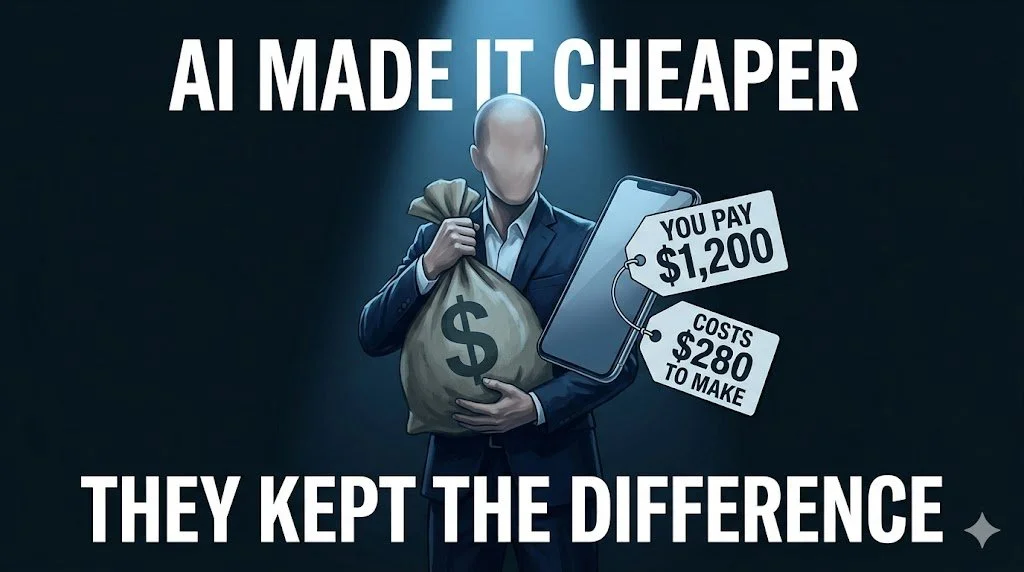
There is a story being told right now by the wealthiest people on earth. It goes like this: artificial intelligence will collapse the cost of goods and services. Things will be nearly free. Abundance is coming for everyone.
Elon Musk has said it. Sam Altman has said it. The pitch decks of every major AI company imply it. The narrative is optimistic, generous-sounding, and strategically useful — because it is being told by the people who intend to own the infrastructure that produces the abundance.
That distinction is the whole story.
YOU Have Seen This Movie Before
In 1956, a top-of-the-line washing machine cost $300 — roughly $3,400 in today's dollars. The same appliance today costs $600 to $900 and does more. Real prices collapsed as manufacturing scaled, supply chains globalized, and automation cut labor costs.
Technology is naturally deflationary. That part is true.
What is also true: the deflation took decades to reach the consumer. The companies that owned the manufacturing captured the efficiency gains first, held prices as long as competition allowed, and passed savings to consumers only when they had no other choice.
AI is that cycle running at higher speed, higher stakes, and with significantly fewer competitors to force the hand.
The $20 AI tool. Price will go up?
The smartphone price won’t come down for awhile!
Here is the most concrete evidence available — no methodology required, no funding disclosure needed. Just a price and a date.
In 2023, OpenAI launched ChatGPT Plus at $20 per month. Google, Anthropic, and Microsoft followed with premium consumer tiers at or near the same price point.
Since that pricing was established, the cost to run a single AI prompt has dropped more than 99 percent. OpenAI's API pricing — what developers and companies actually pay to run the same underlying models — has fallen from roughly $30 per million tokens in 2023 to under $1 at comparable capability tiers today. Google's Gemini Flash models still carry a free tier for developers. The commodity cost of AI inference is approaching zero.
The consumer price: $20. Unchanged.
That is not an oversight. That is not a temporary lag while costs stabilize. That is the margin capture model working exactly as designed. The efficiency gain went to the company. The price to you did not move.
The Infrastructure Inflation Nobody Mentions
While the software layer deflates, the physical world required to run it is undergoing the opposite.
Data centers require land, water, and power at a scale that is reshaping energy markets. Capital expenditure forecasts for AI infrastructure are running into the tens of trillions of dollars globally. Power grids are being stressed in ways not seen since the industrial revolution. Water supplies for cooling are becoming a geopolitical input. Specialized construction labor is constrained.
The companies building this infrastructure need to pay for it. The mechanism is not complicated: maintain high fixed retail pricing on consumer software and enterprise platforms, capture the deflationary gains from cheaper model inference, and use the spread to fund the physical buildout.
The consumer is not a beneficiary of this arrangement. The consumer is the revenue source that makes it possible.
The "AI Premium" Layered Onto Everything You Already Pay For
The third mechanism is the most cynical — and the most visible if you know what to look for.
Software tools, enterprise platforms, and consumer electronics are adding AI features — whether requested or not — to protect existing price brackets and prevent their products from becoming cheap commodities.
Adobe added AI features and raised Creative Cloud prices. Microsoft 365 Copilot added $30 per user per month on top of existing subscriptions. Enterprise software vendors across every category are running the same play: attach an AI label, justify the price hold, and capture the efficiency gain internally while billing the customer for the privilege of receiving it.
This is not innovation pricing. It is defensive pricing using AI as the justification. The product cost less to produce this year than last year. The bill went up.
What "Cheap for Everyone" Actually Means
When Elon Musk or Sam Altman describes a future where goods and services approach zero cost, they are describing the output of a system they intend to own. That is not a consumer promise. It is a market position statement delivered with the cadence of philanthropy.
The "abundance for all" narrative does specific, useful work for these companies:
It preempts antitrust scrutiny. It is difficult to argue a company is a monopolist when it is publicly promising to make everything free.
It attracts talent. Engineers want to work on problems that matter. "We are building abundance for humanity" is a more effective recruiting pitch than "we are building margin."
It disarms regulatory pressure. Optimism about consumer benefit is the most effective argument against oversight. It has worked in every previous technology wave.
It justifies current valuations on future promises. A company that will eventually make everything cheap deserves a valuation that reflects that future — regardless of what it is doing to prices today.
The $20 AI Tool = The floor is the falsification test for the promise. If the technology is deflationary and the companies controlling it intend consumers to benefit — the price moves. It has not moved in three years while the underlying cost dropped 99 percent.
The Desk's Finding
The deflation is real. AI is genuinely collapsing the cost of producing intelligence. That part of the story is accurate.
The rest of the story — that this deflation will reach consumers at scale, that goods and services will approach zero, that the little guy benefits — requires a competitive market to transmit the efficiency gain from producer to buyer. That competitive market does not currently exist in AI infrastructure, and the companies building it are actively working to ensure it does not emerge.
The washing machine got cheaper eventually. It took decades, required real retail competition, and happened only when the manufacturers had no other option.
AI may follow the same path. The timeline will be long. The distribution will be uneven. And the people telling you abundance is coming are the same people currently pocketing the margin between what it costs to run a prompt and what they charge you to use one.
That is not cynicism. That is the documented structure of the current market.
The question to ask any vendor, platform, or technology leader making deflationary promises: if your costs dropped 99 percent, show me where that went in my bill.
If they cannot answer that question, you have your answer.
— The Local Aim Due Diligence Desk · Orange County, CA · May 2026
See where you actually stand. We review your Google presence, current vendor claims, review velocity, and competitive positioning — and show you exactly what we find. No cost. No obligation. No pitch until you ask.
Book a free audit: calendly.com/kirby-thelocalaim/15min
No contract · No agency overhead · You keep everything
The Local Aim · thelocalaim.com · Orange County, CAkirby@thelocalaim.com · 949-832-7575Independent. No agency markup. No vanity metrics. No contracts.