
What marketers don't want you to know.
Weekly column exposing the specific tactics, dark patterns, and agency playbooks actively costing local business owners money right now. Current and tactical, not trend-tracking.
Who it's for: Local business owners being pitched by vendors, agencies, and marketers — the reader deciding whether to sign a contract or write a check.
Our editorial standards and sourcing approach are published here.
The Local Aim · Ongoing Weekly Column
Buyer Beware.
What Marketers Don't Want You to Know
A recurring column exposing the tactics, dark patterns, and agency playbooks that cost local small business owners money — without delivering real results. Not scams. Standard industry practice. That's the problem. We explain the mechanics so you know what you're buying before you buy it.
Why This Column Exists
Most small business owners are excellent at what they do. They are not trained marketers. That gap gets exploited — constantly and systematically — by agencies, software vendors, and consultants who know exactly how to obscure what they are doing and why.
This is not about scams. Most of what we cover is completely legal. It is standard practice. That is the problem.
We write this column so the next time a salesperson walks in with a deck full of impressions, reach, and engagement — you know exactly what questions to ask.
What we cover
- Vanity metrics dressed up as results
- Fake urgency and manufactured scarcity
- Long contracts with auto-renewal traps
- Automated review blasts that violate platform rules
- Ranking guarantees that mean nothing
- Social media hype with no conversion path
- Black-box reporting that hides inactivity
- Junior staffers running accounts they've never visited
Current & Upcoming Issues
The Playbook They Use
Issue No. 01
The Vanity Metric Shell Game
Your agency sends a monthly report full of charts. Impressions up 40%. Reach up 22%. Engagement strong. One problem: none of those numbers connect to a phone call, a booked appointment, or a dollar in your register.
The tell
If your report doesn't show calls, form fills, direction requests, or revenue — you are paying for a story, not results.
● Published
Issue No. 02
Fake Urgency. Real Money Lost.
The email arrives Tuesday: "Limited spots — pricing increases Friday." It was sent to 4,000 businesses. The pricing doesn't change Friday. This is a manufactured close technique designed to short-circuit your judgment before you can think.
The tell
Any offer with a deadline that can't be verified externally is pressure, not value. Ask them to hold the price for a week. Watch what happens.
● Published
Issue No. 03
The Contract Trap
Twelve-month agreements with 60-day cancellation clauses and automatic annual renewals. By the time you realize results aren't coming, you're legally committed for another year — and the clock resets if you miss the window by one day.
The tell
Any agency requiring a 12-month contract up front is pricing in your eventual disappointment. Results-confident agencies work month to month.
● Published
Issue No. 04
The Automated Review Blast
Software blasts your entire customer list simultaneously. Google detects the velocity spike. Reviews get filtered or removed. The vendor's dashboard still shows "reviews sent." Nobody mentions the suppression. You pay. They move on.
The tell
Ask for their real-world review conversion rate. If they quote survey data instead of observed data — they don't know, or don't want you to.
● Published
Issue No. 05
The Ranking Guarantee
"We guarantee Page 1 rankings." For what keyword? In what timeframe? Verified how? Rankings depend on Google's algorithm, your competitors' actions, and dozens of variables no agency controls. The guarantee is a sales tool, not a commitment.
The tell
Ask them to put the guarantee in the contract with a refund clause. The conversation changes immediately.
○ Coming Soon
Issue No. 06
Social Media as a Distraction
You're paying $800/month for three Instagram posts a week. Followers grow. Likes come in. Meanwhile your Google Business Profile hasn't been touched in eight months and your competitor is taking every call you're not getting.
The tell
Ask for a straight line between your social spend and a closed transaction. If they can't draw it, the money is buying activity — not business.
○ Coming Soon
Consumers: Your Voice Creates Accountability
If you've had a bad experience with a local marketing agency — or watched a small business owner get taken advantage of — we want to hear about it. Your stories inform what we investigate and who we protect next.
→ Submit Your StoryWho writes this
Kirby.
The Local
Aim.
I've spent over a decade watching honest local businesses get crushed by algorithms they didn't understand — and ignored by agencies that handed their reputation to a junior staffer or a bot.
I built The Local Aim to fix that. We publish independent, research-driven insights based on what actually works — not agency playbooks, not trends, not theory. When owners ask for help, we tell them the truth first.
Buyer Beware is the editorial side of that mission. No product to sell in this column. No affiliate relationships. No sponsored content. Just the mechanics explained clearly so you can walk into any marketing conversation knowing exactly what you're looking at.
Want to Know Where You Actually Stand?
We'll review your Google Business Profile, review recency, competitive positioning, and AI search visibility — and show you exactly what we find. No cost. No obligation. No pitch until you ask for one.
Request Your Free Audit20 minutes. Free. You keep the findings.

10 Red Flags an AI Tool Is Being Sold to You, Not Solving a Problem
Every few years a new technology shows up, and every few years local business owners get sold the same panic.
10 Red Flags to help you.
What AI Actually Reads Before Recommending a Local Plumber (It's Not What Marketing Gurus Tell You)
A popular marketing YouTuber told his audience that Reddit and software review sites like G2 are what AI reads before recommending a business. That's true — if you sell software. If you're an HVAC company in Costa Mesa, it's almost entirely beside the point. Here's the verdict, source by source, and what actually moves the needle for a home services business.
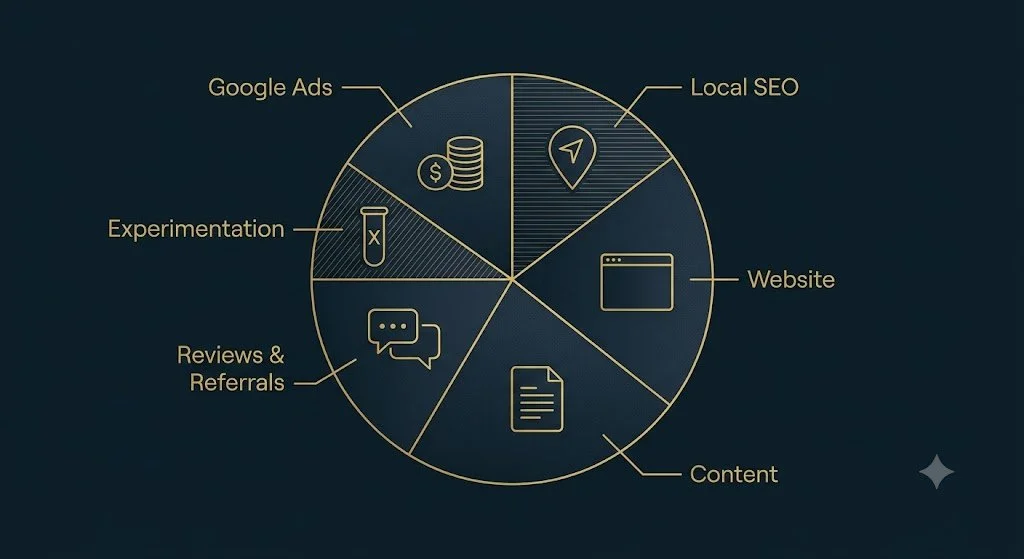
If You Had $100,000 to Spend on Marketing This Year, Would You Put It All in Google Ads?
Most home services owners either overspend on Google Ads because it's the tap they know how to turn, or avoid it entirely because the cost per lead scares them. We ran the numbers on what a real $100,000 budget should look like — and the answer is neither extreme. Here's the honest split, and why the businesses that win long-term never put all their money in one channel.

cARPET cLEANING - The "One Free Room" Trap: Why Honest Pricing Outsold the Upsell
"One room free" sounds generous. Most carpet cleaning companies use it to get a foot in the door, then make their real money once the technician's already inside the house. One company stopped doing it.
Their sales went up the next month.
A lot of owners worry that being upfront about pricing scares off price-shoppers.

Google Told You Exactly How to Get More Customers.
Your competitors are paying for ads. The businesses beating them are doing something Google told everyone to do for free.

When a Negative Review Is Actually a Weapon — And How to Fight Back
A competitor posed as a customer, booked a cleaning job, manufactured a damage claim, and left a one-star review. Then filed an insurance complaint. This is happening to small business owners right now. Here is what to do before it happens to you. Or how to handle it best in the future

Buyer Beware: The Review Software You're Paying For May Be Breaking Federal Law
Nobody wants to deal with a bad review — not the business owner, and not the company selling them the software to manage their reputation. For years, an entire industry built itself around quietly filtering out the negative ones. The federal government just said that's illegal.

They Put AI in the Name. Your Price Went Up. Nothing Else Changed.
Your agency just sent a new proposal. Same services. Higher price.
AI. Here's exactly how that works — and the five questions that cut through it.

AI Is Not Intelligent. It Is Fast. There Is a Difference.
Every AI pitch you've heard in the last two years is built on the same assumption: that fast equals intelligent. It doesn't. Speed is what we can measure. Intelligence is what we infer from it — and that inference is where the sales pitch lives. Before you spend another dollar on AI tools or consultants, read what the independent research actually shows about the gap between what AI can do and what it's producing for businesses like yours.

You Googled It. You Found Agreement. That Is Not Research.
Three things every small business owner must do before buying any marketing service. Skip one and you are probably getting ripped off.

Your Five-Star Rating Is a Target. Here Is What Happens Next.
A WhatsApp message arrives from Pakistan. Someone has ordered 20 fake one-star reviews for your business. Pay up or watch your rating collapse. This is not a hypothetical. It is a documented, operational extortion business targeting the exact kind of service-area company that depends most on its Google reputation.

There Are Three Kinds of Lies: Lies, Damn Lies, and Local SEO Statistics.
The phrase is over a hundred years old. Mark Twain popularized it. Benjamin Disraeli may have coined it. The local SEO industry has spent the last decade proving it. Here is the evidence, source by source.

Before You Sign That Marketing Contract, Read This First
Every marketing salesperson walks in with a glossy deck, a confident pitch, and a number that sounds reasonable until you read the contract. Most small business owners find out what they actually bought three months and several thousand dollars later. This desk looked at what the research says, what the red flags look like in real life, and what questions cut through the pitch before you hand over a dollar.

AI Marketing can be spam. automated & cheap for marketer’s. Same junk for small business and low results.
50% of all small businesses are pumping out AI content at lightning speed right now—but they’re burning their best relationships in the process - the good customer they want to keep!
If you’re using AI tools straight out of the box without real customer data, you aren’t saving time.
You’re just automating your own irrelevance.
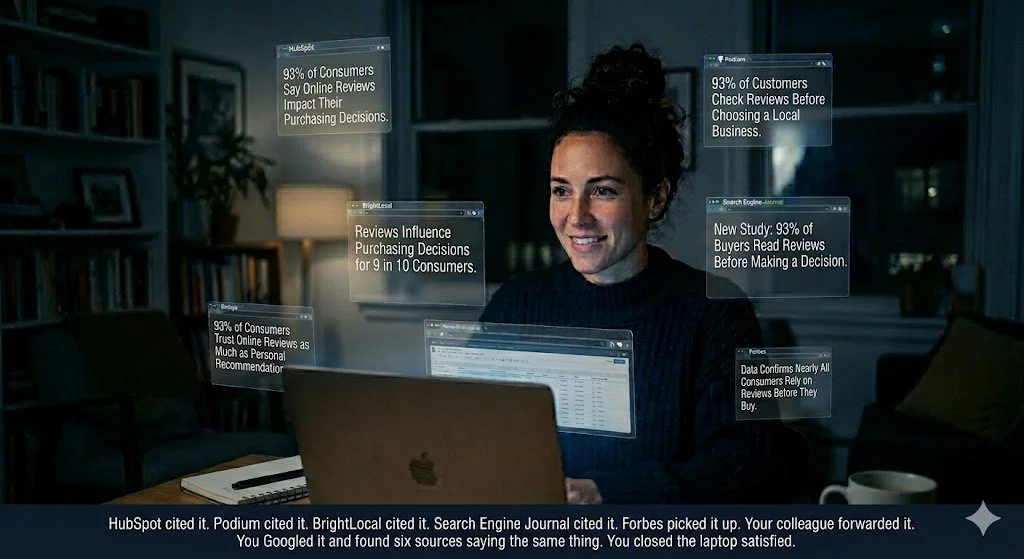
"I Did My Research" — You Found Consensus from marketer’s who want to sell you.
The RESEARCH ILLUSION”
The research process most small business owners actually run:
Google the topic
Read whatever ranks first
Ask someone they trust
That person repeats something they read in step 2
Decision made — feels like due diligence
The only research that actually answers the question ….

You Think You're Too Smart for Clickbait. That's Exactly How It Works.
What’s Authority Bias and clickbait???
Most people believe they can spot manipulation when they see it. The research says otherwise — and the research is not close. They work on the confident reader, the skeptical business owner, and the informed patient precisely because those people believe they are exempt. This desk explains how the same playbook runs in your social feed and in your vendor's pitch deck — and what to ask before either one costs you something you can't get back. Otherwise by another name its, Propaganda to influence all of US! Another name is “the algorithm”.

Are Marketing Agencies Making Up Your ROI Reports? What Local Business Owners Need to Know
Every month, thousands of local small business owners receive a marketing report.
And somewhere in the back of their mind, the owner wonders — why aren't the phones ringing more?
The answer is that most agency reporting is built on metrics that were chosen specifically because they are easy to produce, easy to present, and almost impossible for a client to connect to actual revenue. That isn't a bug in the system. It is the system.
This is not about fraud. It’s been standard practice in local marketing for over a decade.
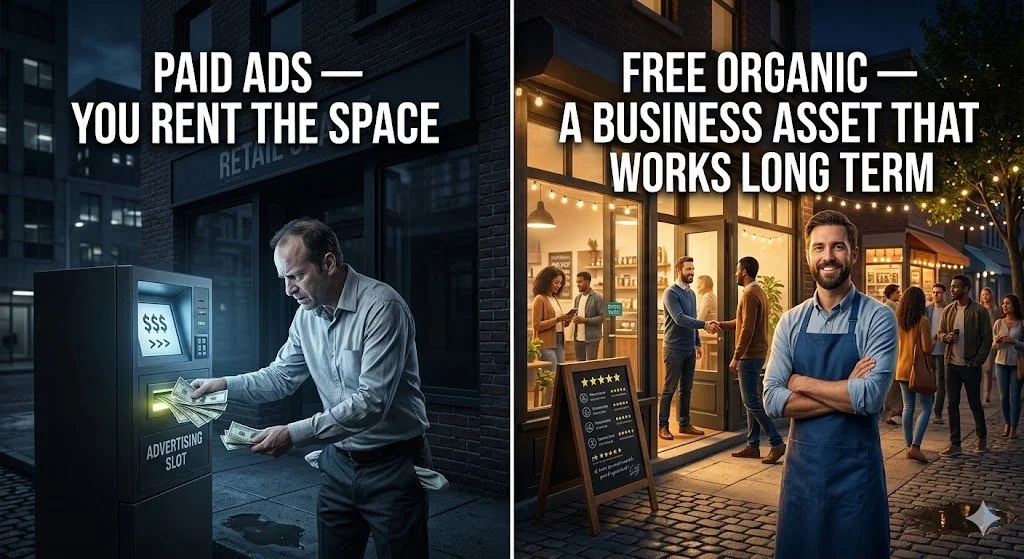
ChatGPT just started showing ads. The businesses that built organic visibility before the paid layer are the ones getting recommended — for free — while everyone else writes a check.
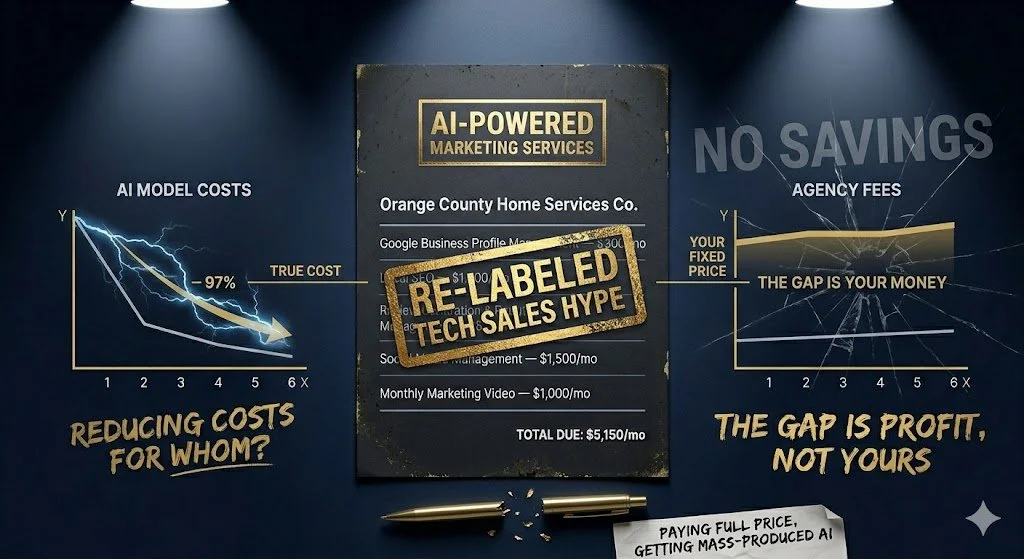
They Call It AI-Powered. They Meant Cheaper to Run for them.
Your vendor's costs dropped. Your bill didn't. Here's what's actually in the package labeled "AI-powered" — and the five questions that cut through the pitch before you sign anything.
What does small business want?
We don’t want to build software ourselves with AI.
We want professional software companies to use AI to build us better products at lower prices and pass some savings on, to to us. The local small business.

Nobody Is Watching the Code
Google's CEO just admitted AI writes most of their software. Here's what that means for the tools running your business.
Set it and forget it is how you find out something broke six months ago.
Every vendor that went "AI-powered" last year deserves a harder look than they're getting.
The review platform, the booking system, the payment link — when did you last test them yourself?
Cheaper and faster are not the same as working.
Your customers will tell you something is broken. Or they'll just call someone else.
The businesses that protect those parts of their operation are the ones that will be findable, trusted, and busy in 2027. The ones that hand everything to a platform because it's cheaper are going to find out what "approved by an engineer who glanced at it" actually means when it's their customers on the receiving end.
Likes, impressions, and reach don't pay your people.
Views, clicks, and followers don't keep the lights on.
Phone calls do.
We get the call to your door. The rest is yours.

Frequently Asked Questions
How do I know if my marketing agency is actually delivering results?
Ask for a direct line between their work and your phone calls or booked appointments. If their monthly report shows impressions, reach, and engagement but cannot show you calls generated or revenue attributed — you are paying for activity, not results. A results-confident agency tracks calls. Everyone else tracks what is easy to show.
What is a vanity metric in marketing?
A vanity metric is any number that looks impressive but does not connect to revenue. Impressions, reach, follower count, and engagement rate are the most common examples. They measure activity. They do not measure whether your phone rang or whether a customer walked in. Likes and impressions don't pay rent. Phone calls do.
What should a small business owner ask before signing a marketing contract?
Four questions matter most. What does success look like in 30 days in calls or booked appointments? How do you attribute a phone call to this specific spend? What is your real-world conversion rate with clients like me — not survey data, observed data? And who specifically will be managing my account day to day? Those four questions tell you everything about who you are sitting across from.
Why do marketing agencies use long contracts?
A 12-month contract with a 60-day cancellation window and automatic renewal is not a sign of confidence. It is a sign that the agency is pricing in your eventual disappointment. Agencies that deliver results work month to month. Long contracts protect the agency — not you.
How do I get my local business to show up in AI search in 2026?
AI search rewards the same things that have always made a local business trustworthy — specific reviews, an active and accurate Google Business Profile, consistent name and address information across the web, and content that answers real customer questions directly. Being online does not mean you are being found. Being found does not mean you are being called. The businesses showing up in AI search in 2026 are the ones that built real local presence — not the ones that bought impressions.
More calls to your door.
We help build the visibility that gets your phone ringing. Real people. Real calls. No inflated promises.
We try and help local businesses get found, get reviewed, and get called. No sales smoke & mirrors. No agency markup. Just more of the right calls.