
Your Online Feed Isn't Lying to You. It's Shaping You.
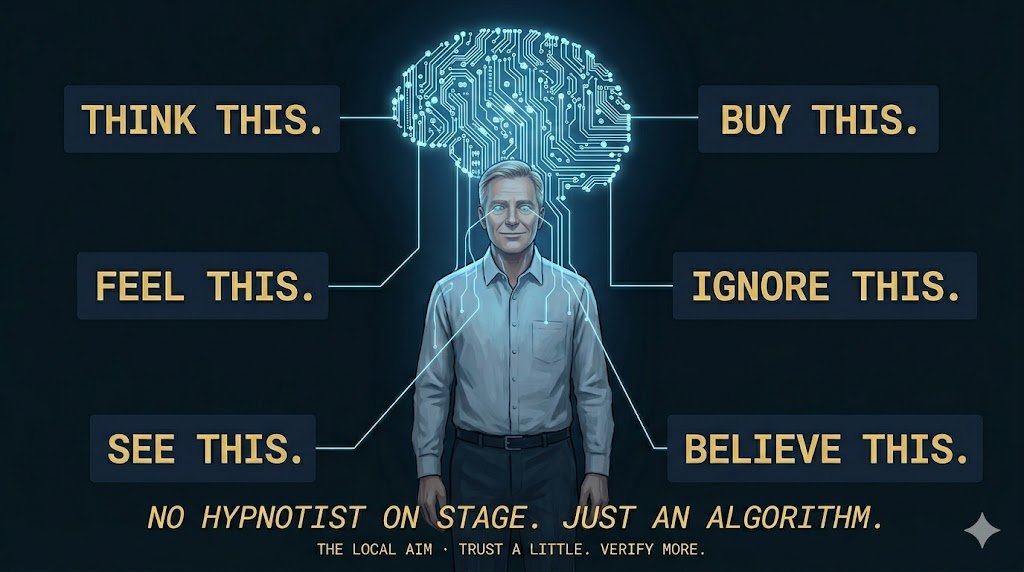
Research · The Local Aim · June 2026
AI and manufacturing automation cut the cost to build a smartphone significantly over the last five years. Those savings did not flow to you. They were captured as margin by the manufacturer, the carrier, and the retailer. Meanwhile tariffs, supply chain restructuring, and component sourcing shifts gave every player in the chain a new justification to raise prices. The result: it costs less to build your phone than it did in 2019 and you are paying more for it. That gap between what it costs them and what it costs you is not accidental. It is the business model.
The Local Aim has never liked being told what to do. Never liked being played. And we have spent enough time on the front lines of sales, marketing, media, and consulting to know the difference between what the training manual says and what actually happens when real money is on the table.
The training manuals says treat the customer right. The front line says sell or you are not there anymore. The gap between those two things is where most of the damage happens — and that gap is now being engineered at a scale that would have been unimaginable twenty years ago.
It is not the con artists you look out for. Con artists are obvious. You see them coming.
It is the middle group. The platforms. The agencies. The vendors. The institutions. The ones who are not lying outright but are not telling you the truth either. The ones who have built systems — algorithms, feeds, recommendation engines, search results — that decide what you see, in what order, with what framing, before you ever make a conscious choice.
That is what this article is about. Not social media. All of it. Every digital surface you touch every day.
This Is Not a Social Media Problem
Most people frame this as a social media problem. It is not. It is an algorithm problem — and algorithms now run everything.
Google search results are an algorithm deciding what is true enough to show you first. The businesses that appear at the top did not earn that position through quality alone. They earned it through a combination of technical optimization, budget, and signals that Google's system values — which may or may not correlate with what is actually best for you.
YouTube autoplay is an algorithm deciding what you watch next — and the documented pattern is that it escalates toward more emotionally activating content with each click because emotionally activating content produces longer watch time. Longer watch time produces more ad revenue. Your emotional state is the product.
Amazon recommendations are an algorithm deciding what you want before you know you want it — based on what people who bought what you bought also bought, weighted toward margin and inventory targets you will never see.
Apple News, Google News, and every aggregator in between are algorithms deciding what counts as news today — not editors, not journalists, not anyone accountable to a standard of verification.
Spotify decides what music shapes your mood. Navigation apps decide what route shapes your geography. Dating apps decide who you meet. Job platforms decide who sees your resume.
Every one of these systems has an optimization target. None of those targets are your best interests. They are engagement, retention, revenue, and the perpetuation of the platform itself.
But, to be fair, these very algorithms tailor, customize, and individualize based on what you search for: on what you want, what you buy, what you need, etc. In that sense, algorithms can be good. Let's face it, we all want convenience today.
Propaganda 2.0 — The Most Powerful Influence System Ever Built
History has seen influence campaigns before. State-sponsored propaganda, manufactured consensus, controlled information environments. These systems required enormous resources, centralized control, and visible infrastructure. They were detectable. They could be resisted.
What exists now is different in kind, not just scale.
Modern algorithmic influence does not require centralized control because it does not need to push a single narrative. It works by personalizing reality — giving each individual a slightly different version of the world, optimized to keep them engaged, which means optimized to confirm and amplify what they already believe.
The result is not that everyone is told the same lie. The result is that everyone lives in a slightly different version of reality — each one feeling personally chosen, each one feeling like the result of their own free inquiry — and none of them easily comparable to anyone else's.
That is more powerful than any previous propaganda system because it is invisible, personalized, and self-reinforcing. You cannot easily show someone their filter bubble from the outside. They are inside it. It feels like the world.
For consumers this means the products you discover, the reviews you trust, the prices you accept as normal, and the vendors you consider credible were all pre-selected by systems designed to serve commercial interests — not yours.
For small business owners it means the marketing advice you see, the platforms you are told you must be on, the agencies you are told deliver results, and the tools you are told are industry standard were all amplified by the same systems. The content that gets distributed is the content that serves the largest players. Small business owners absorb the cost of decisions made on the back of that manufactured consensus every month.
The Tech-Down Power Structure
This does not happen by accident. It happens because the people who build and control these systems benefit from the current architecture.
The largest technology platforms are among the most valuable companies in human history. Their value is derived almost entirely from data — your behavior, your preferences, your attention, your purchasing patterns — collected at scale and sold to the highest bidder or used to optimize the platform's own commercial interests.
The institutions that benefit from existing power structures — financial, political, commercial — have every incentive to work with rather than against systems that can shape perception at scale. Not through conspiracy. Through alignment of interests. The algorithm does not need to be told to serve power. It is built by people who work within existing power structures and optimize for metrics that existing power structures reward.
The trajectory is not hidden. It is documented in regulatory filings, academic research, and the public statements of the people building these systems. More data. More personalization. More integration between digital platforms and the physical infrastructure of daily life. Smart cities. Digital identity. Central bank digital currencies. Each one a new surface for algorithmic influence over individual behavior.
The question is not whether this is coming. It is already here. The question is whether you are navigating it consciously or being navigated by it.
What Consumers and Small Business Owners Can Do Right Now
This is not an argument for paranoia or paralysis. The 51 percent of this system that is useful — the genuine convenience, the real information, the actual connections — is worth using. The 49 percent that is manipulation, extraction, and manufactured consensus is worth naming and resisting.
Here is what resistance looks like in practice:
Search the same question on multiple platforms. Google, Bing, DuckDuckGo, Perplexity. Compare what comes up. The differences tell you what each algorithm is optimizing for.
Check the source before you share or act. Who funded the research behind this claim? What was the methodology? When was it published? Any claim that cannot answer all three is not a fact. It is a pitch.
Separate the recommendation from the recommender. When a platform recommends a vendor, a product, or a service — ask who benefits from that recommendation. The answer is almost never you first.
Verify with humans not just platforms. Call three different people. Ask the same question. If you get three different answers you do not have reliable information yet. If you get the same wrong answer three times that is evidence of systemic failure — not proof the answer is right.
Trust a little. Verify more. Then verify again.
The algorithm does not know you. It knows your pattern. Those are not the same thing. The moment you act outside your pattern — search something unexpected, click something the system did not predict, demand a source for a claim you would normally accept — you are no longer being navigated. You are navigating.
That is the only protection available. And it is available to anyone who decides to use it.
It is not the con artists you look out for. It is the middle group that wants to separate business owners and consumers from their money. The algorithm just gave them a bigger room to work in — and made the walls invisible.
We check. We verify. We call it what it is.
— The Local Aim · Orange County, CA · June 2026
Book a free audit: calendly.com/kirby-thelocalaim/15minNo contract · No agency overhead · You keep everything