
Who likes Sales Hype, Bait and Switch, Incompetence, and Marketers That don’t Care or Deliver???
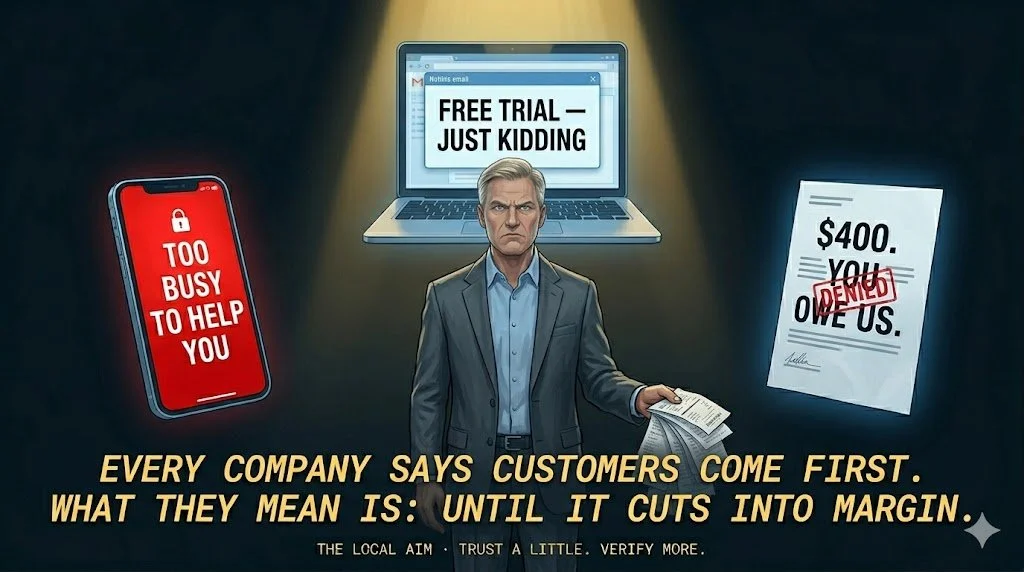
Watchdog · The Local Aim · June 2026
This happened to us this week. It has probably happened to you too — you just did not have a name for it yet.
A tool you were paying for locked you out when you needed it. A free platform pressured you to upgrade with fake urgency. An agent made a verbal promise that cost you money. Three different industries. Same playbook. Same assumption about you: that you would not notice, would not push back, and would keep paying.
They were wrong. Here is the documented proof — and here is what to do when it happens to you.
Here is what happened this week.
Loom — Fake Urgency on a Free Account
We signed up for Loom's free version. Not for the first time — we have used it before and came back because we liked it. We signed up knowing it was free. We made that choice deliberately.
Within days the emails started. The message was clear: your trial is ending, upgrade to paid, here is what you will lose.
We had just signed up. We knew exactly what we signed up for.
This is a documented tactic called manufactured urgency. It is designed to trigger loss aversion — the biological fear of losing something you already have — before your rational brain engages. It is not a billing notice. It is a conversion tactic dressed as a billing notice. The price: $35 a month for something we were already using for free.
CLAIM: Loom's urgency emails accurately represent the status of a free account. VERDICT: HYPE bordering on FALSE. FINDING: The emails implied expiration and loss on an account the user knowingly signed up for as free. Designed to trigger loss aversion in users who may not remember exact terms. RECOMMENDATION: Every "your account is expiring" email deserves thirty seconds of scrutiny. Check what you actually signed up for before you click anything.
Quo — Paid Account, Locked Out, Calling the Doctor
We have been on Quo — formerly OpenPhone — for three months. A paid account. Approximately ten calls made in that time.
This week we needed to make a call. Not a prospecting call. A call to our doctor.
The platform returned this message: we are too busy to authorize your access right now.
On a paid account. To make one call. To a doctor.
We know what that message means. Authentication infrastructure undersized for current demand. Load managed by locking paying customers out rather than transparently communicating a service failure. Someone wrote that "too busy" copy. Someone approved it. It is designed to sound casual. It is not casual. It is a service failure with a friendly face on it.
Three months. Ten calls. Billed every month. Locked out when it mattered most.
And here is the detail that says everything: Quo is a VOIP company — a communications platform — with no support email address and no phone support for standard accounts. The only option is a web form.
A phone company you cannot call or email when their service fails you.
CLAIM: Quo provides reliable accessible VOIP service for paid accounts. VERDICT: UNVERIFIED under real conditions — contradicted by documented experience. FINDING: Paid subscriber locked out during normal use. No status transparency. No ETA. No email support. No phone support. A communications platform with no communication channel when it fails. RECOMMENDATION: Before committing to any VOIP platform test the support channel before you need it. If there is no email and no phone number you will find that out the hard way.
United Healthcare — Verbal Promise, $400 Gone, Recording Nobody Will Pull
This one is not a software subscription. This is health insurance. The stakes are different.
After relocating from Oregon to California we needed to transition coverage. A United Healthcare agent told us verbally on a recorded call the plan would be free. A second agent confirmed the same thing. We verified with a second source — the way you are supposed to.
It was not free. The California administrative process requires separate paperwork to qualify for the subsidy. Nobody mentioned that. The result was $400 deducted from a fixed Social Security income. The only recourse is a formal administrative appeal taking two to three months to resolve.
The recording of that call exists. United Healthcare's own system captured it under their standard disclaimer — this call may be recorded for quality assurance. What that phrase does not tell you is that nobody pulls that recording on your behalf when the agent's promise turns out to be wrong. The recording is not protection. It is liability management.
Two agents. Same wrong answer. Verbal confirmation from both. Still wrong. Still $400 gone.
I can't remember everything. But I remember when I'm lied to. That is why we write everything down. Trust a little. Verify more. And then verify again.
CLAIM: United Healthcare agents accurately represented the cost of the plan during enrollment. VERDICT: FALSE — contradicted by the billing outcome and two independent verbal representations that proved incorrect. FINDING: Both agents were either incompetent, inadequately trained on California administrative requirements, or made representations they could not support. The consumer followed best practice, verified with a second source, and was still harmed. RECOMMENDATION: For any insurance enrollment ask the agent to send written confirmation of what was discussed before you hang up. Verbal is not enough. Recorded is not enough. If they will not put it in writing that is your answer.
The Pattern Behind All Three
Three different industries. Three different tools. Three different weeks of someone's life. Same decision made by each one: treat the customer as a revenue target who does not know better.
Loom assumed we forgot what we signed up for. Quo assumed we would not notice being locked out and keep paying. United Healthcare assumed we would not fight a $400 charge on a fixed income.
All three assumptions were wrong. But here is the uncomfortable truth — they work most of the time. That is why the playbook keeps running. Not because the people running it are uniquely evil. Because it is profitable. And because most people do not have the background, the time, or the energy to push back.
There is a rule worth keeping for any interaction with any institution — insurance, government, utility, software platform, or vendor. Call three different times. Talk to three different people. If you get three different answers you do not have reliable information yet. If you get the same wrong answer three times that is evidence of systemic failure not individual error.
Every company says customers come first. What they mean is customers come first until serving them cuts into margin. Then the language changes — and you absorb the cost.
What To Look Out For
Every industry runs a version of this playbook. Here is how to spot it before it costs you.
Fake urgency. Any email implying you are about to lose something — a free account, a special price, a limited offer — deserves thirty seconds of scrutiny before you click. Check what you actually signed up for. The urgency is almost always manufactured. The deadline is almost always fake.
Verbal promises. If an agent, a vendor, or a sales rep tells you something on a phone call — ask them to put it in writing before you hang up. If they will not, you have your answer. A recorded call is not protection. It is liability management for them, not for you.
No support channel. Before you commit to any paid tool or platform test the support channel first. Send a message before you need one. If the response is slow, generic, or nonexistent — that is what you will get when something goes wrong. A VOIP company with no phone support and no email is not a communications platform. It is a billing platform with a calling feature attached.
The margin gap. When a company tells you AI, automation, or technology is making their service better — ask what it is costing them to deliver it now versus two years ago. If costs dropped and your bill did not, the efficiency gain went to their margin, not to you. That is not innovation. That is extraction.
What To Do When It Happens
Document everything. Screenshot the error. Save the email. Write down what the agent said and when. Your documentation is the only protection available when the support ticket goes unanswered and the recording nobody pulls leaves you with nothing but your word against theirs.
Demand it in writing. Before you sign anything, upgrade anything, or agree to anything — get it in writing. Every legitimate vendor will do this without hesitation. The ones who will not are telling you something.
Push back. File the support ticket. Request the refund. Submit the BBB complaint. Post the honest review. Most people do not push back — and that is exactly why the playbook keeps running. The moment you do, you are no longer the easy target.
Call three times. For any institution — insurance, government, utility, vendor — call three different times and talk to three different people.
If you get three different answers you do not have reliable information yet. If you get the same wrong answer and / or different answers three times that is evidence of systemic failure — and you have grounds to escalate.
Trust a little. Verify more. Then verify again.
We check. We verify. We call it what it is. That is why this desk exists.
— The Local Aim · Orange County, CA · June 2026
Book a free audit: calendly.com/kirby-thelocalaim/15minNo contract · No agency overhead · You keep everything