BUYER BEWARE · THE LOCAL AIM · DUE DILIGENCE DESK
May 2026 · Orange County, CA · Independent. Verified. No Hype.
———
THE AD JUST SHOWED UP INSIDE THE ANSWER.
HERE IS WHAT THAT MEANS FOR YOUR BUSINESS.
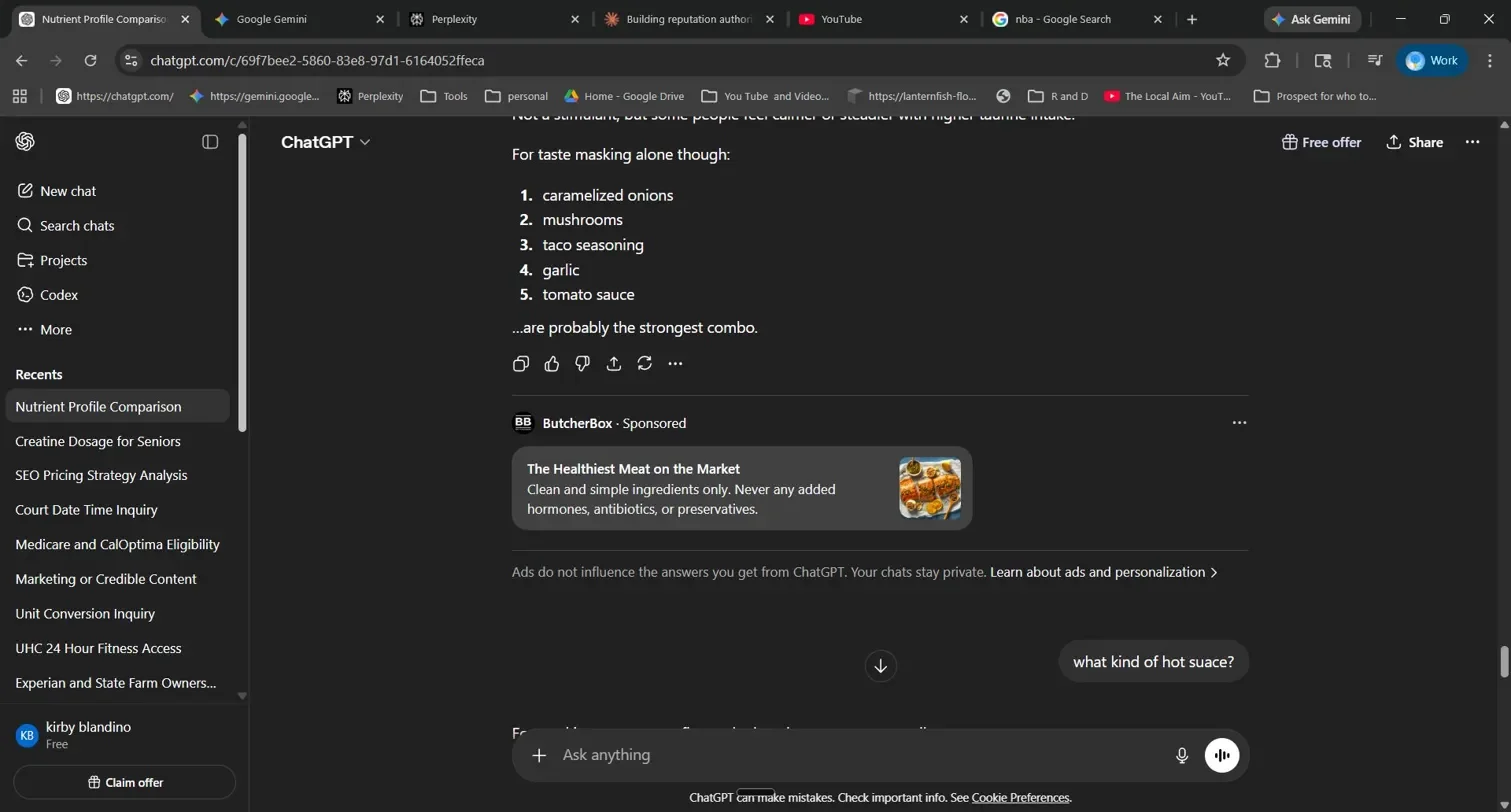
Someone asked ChatGPT about food. A ButcherBox ad appeared mid-response — labeled "Sponsored," below the answer, matched to the conversation. That screenshot is not a curiosity. It is a preview of where every AI platform is going. And the small business owners who understand what is happening right now are the ones who will still be visible when the paid layer takes over.
———
WHAT JUST HAPPENED
OpenAI launched advertising inside ChatGPT on February 9, 2026. Ads appear below responses for users on the Free and Go ($8/month) tiers — clearly labeled "Sponsored," matched to whatever the user is discussing. Users who pay $20/month or more do not see ads. The rest of the platform — hundreds of millions of free users — do.
The disclaimer ChatGPT displays reads: "Ads do not influence the answers you get from ChatGPT. Your chats stay private."
That statement is accurate for today's implementation. It is worth watching carefully as the format evolves.
———
THE MONEY BEHIND THE MOVE
OpenAI posted cumulative losses exceeding $13.5 billion in the first half of 2025 alone — despite $12.7 billion in annual recurring revenue. The company is not profitable. Its own internal projections target profitability by 2029. Advertising is the lever that gets them there.
EMarketer projects AI-driven search advertising spending in the U.S. will grow from $1.1 billion in 2025 to $26 billion by 2029. That is not a rounding error. That is the same growth curve Google Search ran in its first decade, compressed into four years.
OpenAI's internal strategy for this is labeled "intent-based monetization." The current Paid Ad & style placement — a sponsored unit below the answer — is the conservative opening move. What is being prototyped internally is more significant: generative ads where ChatGPT constructs the recommendation itself, selecting which product features to mention and testing different framings to improve conversion. The ad would not appear below the answer. The ad would be woven into it.
That is not live today. It is in development.
———
WHO CAN AFFORD THIS — AND WHO CANNOT
The entry cost for ChatGPT's early advertising program is approximately $1 million in spending commitment. The CPM rate is around $60 per 1,000 impressions — nearly three times what Meta charges.
A plumbing company in Anaheim is not buying into that program. Neither is a cosmetic dentist in Irvine or an HVAC contractor in Costa Mesa.
That is not the point.
The point is not whether your business can buy the ad. The point is what the ad displaces — and who benefits when the organic answer is still the only thing running.
———
THE WINDOW THAT IS STILL OPEN
Right now, when someone on ChatGPT Free asks "best HVAC company in Costa Mesa" or "top-rated cosmetic dentist near me," the answer is assembled from organic sources: Google reviews, local directories, third-party editorial citations, and GBP data. No one paid to be in that answer. The AI recommended them because the signal was there.
That is the window. It is open. It will not stay open at the same width indefinitely.
Google's own history makes the trajectory clear. In its early years, Google maintained sharp separation between organic results and paid placements — and that separation is what made users trust it. As the platform scaled, the ad formats expanded, the load increased, and the visual distinction between paid and organic blurred. What was once two clearly labeled sponsored links above ten organic results is now, in many queries, four ads, a local pack, a sponsored unit, AI Overviews, and two organic links below the fold.
ChatGPT is in the early phase of that same arc. 2026 is the "labeled unit below the answer" phase. 2028 will look different.
———
WHAT THIS MEANS IF YOU OWN A LOCAL BUSINESS
The businesses that are building organic AI visibility right now — real reviews with specific language, consistent GBP data, editorial citations from credible local sources — are building something the paid layer cannot easily displace.
Here is why.
AI systems do not recommend businesses the way Google serves ads. They synthesize signals from multiple sources and surface what appears most credible and most relevant to the query. A business with 60 recent reviews describing specific services in specific cities, owner responses on every review, complete GBP data, and third-party editorial mentions does not get knocked out of an AI recommendation by a CPM buy. The organic signal is the recommendation. The ad is the sponsored unit below it.
The paid layer monetizes the free users. The organic signal still controls the answer.
That dynamic will compress over time as ad formats evolve. But it is the reality of the market right now — and the businesses that wait until the paid layer is fully built to start building organic presence will be starting from zero in a more expensive environment.
———
THE DESK'S VERDICT
The ChatGPT ad launch is real, confirmed, and expanding. The entry cost makes it an enterprise play for the foreseeable future — not a small business channel. The more significant development is what comes next: intent-based monetization that embeds commercial recommendations into AI responses rather than labeling them separately. When that format becomes standard, the distinction between "the AI recommended your business" and "someone paid for your business to be recommended" becomes harder to see and harder to trust.
The organic recommendation is the asset worth building — because it is the one that survives the paid layer. Reviews that describe real work in real places. GBP data that tells AI exactly what you do and where. Editorial coverage from credible local sources that gives AI something to cite. None of that requires a seven-figure ad commitment. All of it compounds every month it is in place.
———
THE GOOD NEWS FOR SMALL BUSINESS
The paid layer is coming. But it is not here yet — not at the local level, not in the conversational AI recommendation that answers "who should I call for a new AC unit in Costa Mesa."
That answer is still assembled from organic signals. And the businesses that build those signals now own the recommendation before the market prices it out of reach.
There is a structural advantage in being small and local right now. A national brand buying ChatGPT ads at $60 CPM is paying to reach everyone who asks a related question — most of whom are not in your city, not in your service area, and not your customer. The organic AI recommendation for a hyper-local query still belongs to the business with the best local signal. That is a reviewable Google profile. That is 30 recent reviews with city names and service descriptions in the text. That is an owner who responds to every review. That is a local media mention with your name, your category, and your geography attached to a credible third-party source.
None of those things require an ad budget. All of them require consistency.
The window is open. The businesses building now will be the ones competitors are trying to catch in 2028 — when the paid layer is fully built and the organic signal is the only thing that cannot be bought.
Build it now. It compounds. The paid layer cannot take that from you.
———
— The Local Aim Due Diligence Desk · Orange County, CA · May 2026
See where you actually stand. We review your Google presence, current review velocity, AI search visibility, and competitive positioning — and show you exactly what we find. No cost. No obligation. No pitch until you ask.
Book a free audit: calendly.com/kirby-thelocalaim/15min
No contract · No agency overhead · You keep everything
———
The Local Aim · thelocalaim.com · Orange County, CA
kirby@thelocalaim.com · 949-832-7575
Independent. No agency markup. No vanity metrics. No contracts.
See Image below for a genral nutrition Question posed to Chatgpt