
He Owns the Product He's Recommending. Did You Notice?
CONSUMER BEWARE · THE LOCAL AIM · DUE DILIGENCE DESK
May 2026 · Orange County, CA · Independent. Verified. No Hype.
———
"GIVE ME 21 MINUTES AND I'LL GIVE YOU PERFECT VISION NATURALLY"
THE DESK LOOKED AT WHAT THAT TITLE IS ACTUALLY SELLING.
A YouTube video promises perfect vision in 21 minutes. The creator recovered from 20/80 to 20/15 "naturally." The science sounds specific. Seven habits. Named wavelengths. Circadian biology. And at the top of the video description, before the content even starts, there is a discount code for a product he founded and profits from. This desk ran the claims.
———
THE CONFLICT OF INTEREST NOBODY MENTIONED
The video opens with: "Try TrueDark (with my discount): truedark.com/discount/DAVETUBE"
TrueDark is not a sponsor in the traditional sense. TrueDark was founded by Dave Asprey. It is his company. He built it, branded it, and runs an affiliate program that pays third parties 20% commission on every pair sold. When the creator of a video recommends a product he owns in the first line of his description, that is not a disclosure. That is a storefront.
The video never states this relationship explicitly. It is labeled "Sponsored" in the description — which technically satisfies YouTube's paid promotion flag — but the framing treats TrueDark as an independent third-party recommendation. It is not.
VERDICT: UNVERIFIED AS INDEPENDENT ENDORSEMENT. This is a founder selling his own product inside content designed to look like objective health education. The omission of that relationship in the video itself is a material disclosure failure.
———
CLAIM 1: "I went from 20/80 to 20/15 vision naturally."
This is the load-bearing claim of the entire video. Everything else rests on it. If you do not believe this, you do not watch the video. If you watch the video, you are being sold the belief that the result is replicable.
What the desk found: The 20/80 to 20/15 claim appears across multiple Asprey properties — blog posts, podcasts, and videos — spanning at least four years. The story is consistent in its outcome but inconsistent in its methodology. In some versions, he credits three months of intense eye training exercises with a coach. In others, he credits supplements including his own Eye Armor product, which he has stated he takes at three times the recommended daily dose. In this video, the credit goes to seven daily habits including red light, blueberries, cold rinse, grounding, eye fasting, blink training, and sunset viewing. No ophthalmologist is named. No clinical record is cited. No methodology is disclosed. No independent verification exists.
A self-reported anecdote from someone selling products in the same content is not evidence. It is a testimonial. Testimonials are not verifiable, are not generalizable, and cannot establish causation.
VERDICT: UNVERIFIED. Single self-reported claim, no independent clinical documentation, methodology changes across versions, and the person making the claim profits from the belief that the result is achievable. This does not meet the standard of evidence required to be treated as fact.
———
CLAIM 2: Red light at 670nm "directly supports mitochondrial function" and can improve vision.
This is the claim with the most legitimate scientific scaffolding in the video — and the most aggressively overstated conclusion.
What the desk found: There is real published research on 670nm photobiomodulation. A UCL pilot study found that three minutes of daily 670nm red light improved color contrast sensitivity by up to 20% in adults over 40. A separate pilot study of 31 AMD patients showed some functional improvements. Randomized clinical trials in children in China showed red light therapy slowed myopia progression.
What the desk also found: These studies are small. The UCL study involved healthy aging eyes — not correction of refractive error. The AMD studies explicitly note that the precise mechanisms are unclear and that the treatment was not found effective for all macular disease patients. The children's myopia studies tested a controlled clinical device, twice per school day, for months — not a consumer red light device used casually at home.
The video presents 670nm red light as if the science is settled and the consumer result is established. It is not. The science is early-stage, the sample sizes are small, the conditions studied differ from general refractive error, and the consumer application has not been validated in clinical trials.
VERDICT: DIRECTIONAL SIGNAL at best. There is real science behind 670nm light and retinal health. The consumer claim — that using a red light device at home will improve your vision — extrapolates well beyond what the published research supports. The video does not disclose this gap.
———
CLAIM 3: Blueberries "accelerate rhodopsin regeneration" and improve night vision.
What the desk found: Anthocyanins — the compounds in blueberries — do have published research supporting antioxidant activity in retinal tissue and some association with rhodopsin regeneration. This is real biochemistry. The original research connecting bilberry (a close relative of blueberry) to night vision improvement dates to World War II RAF pilot claims — which were later found to be largely unverified. Subsequent controlled studies on bilberry and vision in non-deficient adults have produced mixed results. Blueberries are not bilberry. The anthocyanin content varies by variety, ripeness, and preparation.
The claim that adding blueberries to your diet will measurably improve your night vision is not supported by high-quality clinical evidence in people who are not already anthocyanin-deficient.
VERDICT: DIRECTIONAL SIGNAL. Blueberries are good for you. The specific vision improvement claim is a stretch from the available evidence. Eating them will not hurt you. Expecting them to restore rhodopsin as a primary intervention is not supported.
———
CLAIM 4: "Grounding" — barefoot contact with the earth — lowers oxidative stress and benefits eye health.
What the desk found: Grounding or earthing has a small published literature, primarily funded and produced by researchers affiliated with the grounding products industry. The claimed mechanism — electron transfer from the earth neutralizing free radicals — is not established in peer-reviewed independent research. The American Academy of Ophthalmology does not recognize grounding as a treatment for any eye condition. No published study establishes a direct connection between barefoot ground contact and retinal health.
VERDICT: UNVERIFIED. The mechanism is implausible as stated, the research base is primarily industry-affiliated, and no independent replication exists connecting this practice to vision improvement. The video presents it as established fact. It is not.
———
CLAIM 5: "Perfect vision" is achievable in 21 minutes.
This is the title. It is the reason people click. It is the promise that drives the view count and the affiliate link conversions.
Twenty-one minutes is the runtime of the video. "Perfect vision" is 20/20 or better. "Naturally" means without surgery or corrective lenses.
The video does not deliver a method that produces perfect vision in 21 minutes. It delivers seven lifestyle habits — some with directional scientific support, some without — that the creator claims contributed to his own self-reported vision improvement over an unspecified period of time. The title describes watching the video. The content describes months or years of daily practice.
This is a classic clickbait structure: the title promises an outcome, the content delivers a process, and the gap between the two is filled by the viewer's hope and the creator's personal testimonial.
VERDICT: HYPE. The title is not a claim about the video's content. It is engineered to generate clicks from people experiencing vision decline who are looking for a solution. It does not represent what the video actually delivers. Under FTC guidelines on health content, a title that implies a health outcome the content does not establish is deceptive framing regardless of whether a disclaimer appears at the end.
———
WHAT THE VIDEO GETS RIGHT
In the interest of accuracy, the desk notes the following claims in the video are directionally supported by mainstream science:
Screen time reduces blink rate significantly. Published research confirms blink rate drops from 15-20 per minute to 4-5 in front of screens. The downstream effects on tear film stability are real and documented.
Melatonin has antioxidant properties in retinal tissue. This is established in the literature.
Blue light exposure at night suppresses melatonin production. This is well-established.
Chronic near-focus creates ciliary muscle tension. This is recognized in optometry.
Distance viewing releases that tension. Also recognized.
These are real. They are not controversial. They are also not going to take someone from 20/80 to 20/15. They are eye hygiene practices — useful, low-risk, and appropriately adopted by anyone who spends significant time on screens.
The problem is not that everything in the video is false. The problem is that real hygiene advice is being packaged inside a vision restoration promise — and then monetized through a product the creator owns and profits from. That packaging is the deception, not the individual habits.
———
THE DESK'S VERDICT
The title is clickbait. The personal transformation claim is unverified and self-reported. The product recommendation in the first line of the description is the creator selling his own company's product without adequately disclosing that relationship. The science cited ranges from directional signal to unsupported. The gap between the lifestyle habits described and the outcome promised in the title is not disclosed.
None of the seven habits are dangerous. Several are worth adopting. But the framing — "21 minutes, perfect vision, naturally" — is designed to attract people with real medical concerns about vision decline and redirect them toward content that ends with a product purchase.
If your vision is declining, the correct first step is an ophthalmologist. Not a YouTube video. Not a discount code.
The difference between a health creator and a health marketer is whether the disclaimer comes before or after the link.
———
THREE QUESTIONS TO ASK BEFORE ACTING ON ANY HEALTH VIDEO
1. Does the creator profit from any product mentioned in the content?
If yes, that is not a recommendation. That is a sales channel. Evaluate it accordingly.
2. Is the personal claim — the "I went from X to Y" story — independently documented?
If the only source is the person selling you something, it is a testimonial. Testimonials are not evidence.
3. Does the science cited actually support the outcome claimed — or does it support something more limited that the creator extrapolated from?
Read the actual study. The headline finding is almost never the same as the consumer claim built on top of it.
———
— The Local Aim Due Diligence Desk · Orange County, CA · May 2026
This desk applies the same standard to every claim: named source, disclosed methodology, verified date. Health content that fails those standards gets flagged — not because the topic is illegitimate, but because the framing can cause real harm to real people who trust it.
———
The Local Aim · thelocalaim.com · Orange County, CA
kirby@thelocalaim.com · 949-832-7575
See image below for a common You Tube video and it’s clickbait. Notice the sales hype, the Bias, and its lack of Integrity Trust
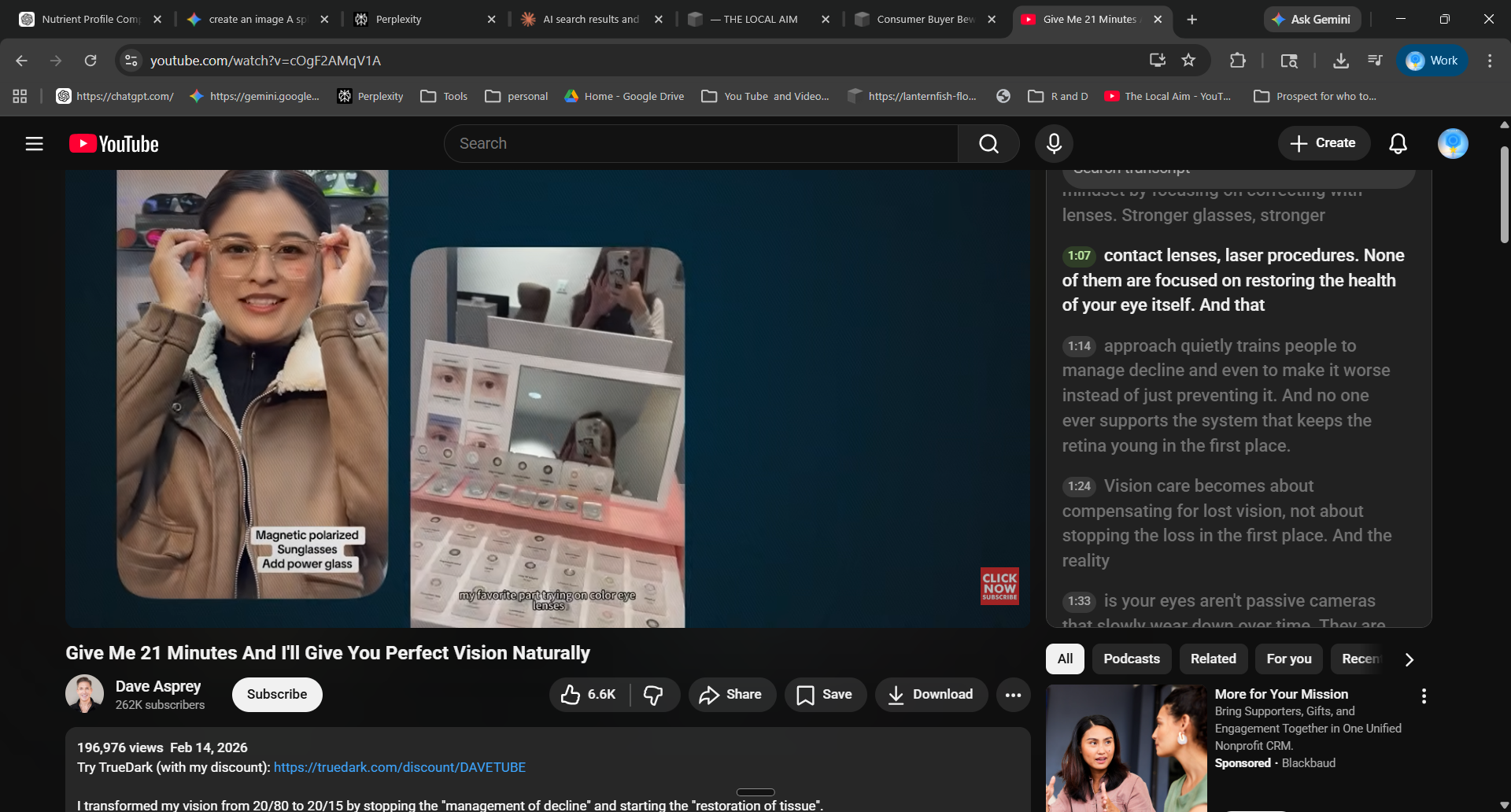
May 3rd, 2026. Screenshot from "Give Me 21 Minutes And I'll Give You Perfect Vision Naturally" — Dave Asprey, YouTube, February 2026. Used for editorial criticism and consumer protection commentary.