How do we build a marketing operation that wins no matter which AI wins?
Business Mindset:
Lowers long-term costs
Preserves flexibility
Protects your competitive advantage
What’s in it for Small Business- Best practice moving forward:
Treat AI as a business strategy, not a tool decision
Stay platform-agnostic
Document workflows generically (“use AI to…”, not “use GPT to…”)
Train teams on AI thinking, not specific interfaces
Regularly benchmark tasks across multiple models
Executive Summary (Marketing Agency + Small Business)
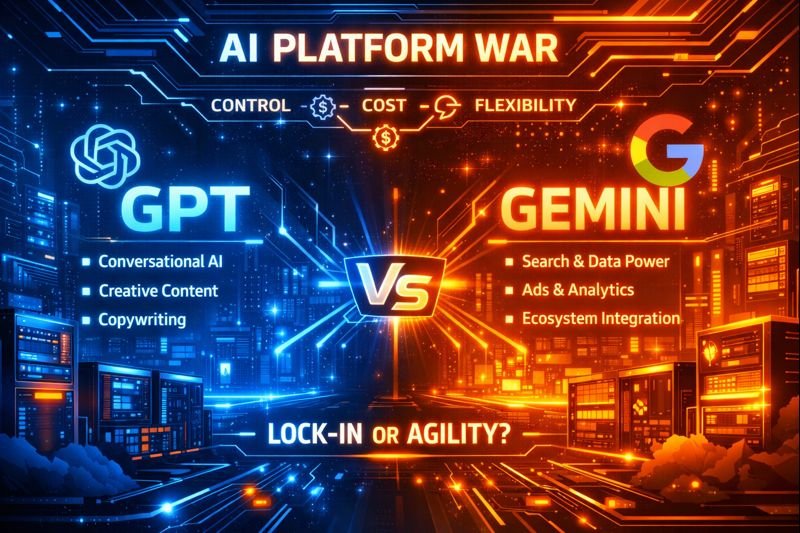
The real difference between ChatGPT (OpenAI) and Gemini (Google) isn’t which one writes better copy. It’s which ecosystem you’re building your marketing operation on — and what that costs you over time.
Most marketers think they’re choosing a chatbot. In reality, they’re choosing a platform that controls their data access, execution speed, pricing power, and long-term flexibility.
The Most Important Points (Plain English)
1. This Is a Platform War, Not a Feature Comparison
Both tools are good at writing content.
The risk is lock-in: prompts, workflows, training, integrations, and reporting systems all become infrastructure.
Once deeply embedded, switching platforms becomes expensive and disruptive.
Key takeaway:
AI choices now affect future marketing costs the same way CMS or ad platforms do.
2. Google’s Structural Advantage Is Data + Distribution
Google has a long-term edge because it owns:
Search intent (trillions of searches per year)
YouTube, Chrome, Gmail, Maps, Ads, Analytics
The full loop between content → discovery → clicks → conversions
Gemini is deeply connected to how people actually search, browse, and buy, not just how they write.
What this means for businesses:
Gemini is naturally aligned with SEO, local visibility, ads, analytics, and demand capture — not just content creation.
3. Business Models Matter (and Affect Pricing)
OpenAI must charge for ChatGPT to survive.
Google does not need Gemini to be profitable.
Google can:
Bundle Gemini into Workspace and Ads
Undercut competitors on price
Use AI to strengthen its ecosystem rather than monetize it directly
Implication:
Over time, Google can make AI cheaper and more integrated — while standalone AI tools may become more expensive.
4. Where Each Tool Is Strong Today
Gemini tends to excel at:
Keyword research & SERP analysis
Pattern detection across live web data
Google Ads, Analytics, Sheets, and SEO workflows
Anything tied to search intent and visibility
ChatGPT tends to excel at:
Conversational, persuasive copy
Brand voice and storytelling
Client-facing explanations and reports
Creative ideation and messaging
Smart teams use both — intentionally.
5. The Real Risk Is Vendor Lock-In
As these platforms mature:
Features will diverge
Pricing will change
Switching costs will rise
Businesses that optimize everything for one AI risk being:
Forced into higher costs
Slower to adapt
Locked into suboptimal workflows
What Smart Agencies & Businesses Should Do
Best practice moving forward:
Treat AI as a business strategy, not a tool decision
Stay platform-agnostic
Document workflows generically (“use AI to…”, not “use GPT to…”)
Train teams on AI thinking, not specific interfaces
Regularly benchmark tasks across multiple models